
By Cami Salisbury, MS, RDN, LDN
Building healthy habits that last requires more than motivation — it takes strategy.1,4Sustainable behavior change follows a simple but powerful cycle: plan, prepare, reinforce, and reflect. At the core of this process is the cue, routine, and reward loop, in which consistent repetition links a trigger (cue) to an action (routine) and the satisfaction that follows (reward).¹,² You begin by creating a clear plan for what to do, then prepare your environment and support system to make that plan realistic.4 Reinforcement helps you stay consistent through small wins and feedback, while reflection strengthens self-awareness and mindset, ensuring progress continues even when life shifts.5,6 The following tools and strategies will help you apply these steps in clear, practical, and achievable ways.
Planning and Implementation Tools
Clear planning transforms good intentions into action. The tools below help turn ideas into repeatable actions, setting the stage for sustainable nutrition and lifestyle habits.
SMART Goals
SMART goals help turn vague intentions into clear, actionable steps. The acronym stands for Specific, Measurable, Achievable, Relevant, and Time-bound — five elements that build structure, accountability, and focus around your goals. Research shows that clearly defined goals and measurable feedback greatly improve long-term success.4 To set a SMART goal, ask yourself:
- Specific: What is the action I will take? When and where will I take this action?
- Measurable: How will I track what I’m doing or know I’ve followed through?
- Achievable: Are these steps realistic for my current schedule and energy level?
- Relevant: How will this SMART goal support my health goals?
- Time-bound: When will I check in to reflect on progress and adjust as needed?
Example:
- Long-term goal: I want to improve my nutrition and lose weight.
- Short-term goal: I’ll eat more vegetables.
- SMART goal: “I’ll add one serving of vegetables to lunch at least three days this week.” This version is clear, trackable, and realistic and will help you build consistency without pressure.
Growth Reflection Questions:
- Did I meet my SMART goal this week?
- What challenges made it difficult, and how can I adjust next week?
- What worked well, and how can I expand on that success?
Habit Stacking
Habit stacking links a new behavior to one you already do consistently, using the existing habit as the cue for the new routine. Over time, this pairing creates a built-in reward, the satisfaction of consistency and improved well-being, making healthy choices feel more natural and effortless.1,3
Example: When putting away food after dinner (existing habit), you might pack tomorrow’s lunch (new habit). Over time, meal prep becomes a natural part of your nightly routine.
Growth Reflection Questions:
- What is one daily habit I already do that could serve as a cue for a new nutrition-related goal
- How can I make this pairing simple and consistent?
Temptation Bundling
Temptation bundling pairs a task you want to do with one you need to do. By combining the two, you increase the immediate reward value of healthy behavior, making it easier to maintain motivation.1,3
Example: Only listen to your favorite podcast while prepping meals or going on a walk. This associates the activity with pleasure, helping you look forward to it instead of feeling obligated.
Growth Reflection Questions:
- What enjoyable activity could I pair with the healthy habit I want to build?
- How would pairing the two make it easier or more enjoyable to stay consistent over time?
Implementation Intentions (If–Then Planning)
Implementation intentions use “if–then” statements to anticipate challenges and outline specific responses. This strategy strengthens commitment and improves follow-through when life doesn’t go as planned.2,4 By linking a specific cue (“if”) to a chosen routine (“then”), these plans reinforce the cue–routine–reward loop, helping healthy behaviors become more consistent and automatic over time.
Example: “If dinner is delayed because of after-school activities, then I’ll serve a quick balanced option like eggs and wheat toast with fruit.”
Growth Reflection Questions:
- What situations tend to disrupt my healthy habits?
- How can I plan ahead for those moments to stay on track?
Environment and Social Support
Even the best plan can falter if your environment doesn’t support it. Research shows that small environmental tweaks, like making healthy options more visible and convenient, can greatly improve habit consistency.1,2 Likewise, supportive relationships build accountability and motivation that sustain change over time., Together, environment and social support create the “prepare” phase of behavior change, making healthy choices easier, more natural, and more sustainable.
Visual & Audio Cues
Your environment influences nearly every food and lifestyle decision you make. Visual and audio cues act as gentle reminders that prompt healthy actions before motivation fades.
Example: Keep a water bottle on your nightstand so you’re reminded to take a sip first thing in the morning, or set a fun song as your alarm to motivate a walk or workout.
Growth Reflection Questions:
- What visual or audio reminder could help me remember the habit I want to build?
- Where could I place or time that cue so it appears right when I need it most?
Reduce Friction for Supportive Habits
The easier it is to start a healthy behavior, the more likely you are to stick with it.2 In habit-building, friction refers to the small barriers like lack of time, low energy, or too many decisions that make it harder to take action. Setting yourself up ahead of time helps remove that friction and keeps those everyday challenges from derailing your progress.
Example: Pack your lunch the night before, prep balanced snacks on Sunday for the workweek, or keep your gym bag in your car so it’s ready when you are. Each small action reduces effort, saves time, and builds momentum for the next day.
Growth Reflection Questions:
- Which healthy habits feel the hardest to start and why?
- What can I prepare ahead of time to make them easier to follow through on?
Add Friction for Less Supportive Habits
Just as removing friction makes healthy choices easier, adding a little friction can help you interrupt habits that aren’t serving you. Small, intentional barriers make automatic behaviors less convenient, giving you time to pause and make a more mindful decision without relying solely on willpower.3
Example: Keep snack foods or sweets in a separate cupboard away from your main kitchen area so reaching for them takes a few extra steps. That small pause gives you time to decide if you’re truly hungry or just craving out of habit or boredom.
Growth Reflection Questions:
- Which habits do I fall into most easily when I’m tired, stressed, or distracted?
- What small change could help me pause before slipping into those routines?
Build a Support System & Communicate Intentions
Having supportive people in your corner makes healthy habits easier to start and much easier to maintain. Sharing your goals out loud strengthens your own commitment and helps others support you rather than unintentionally getting in the way.2,3 When the people around you know what you’re working toward, they can encourage your progress, celebrate small wins, and help make those changes feel more sustainable.
Example: Let your family know you’re focusing on balanced dinners so everyone can plan together or offer ideas. You might also tell a friend about your goals and send a quick text when you complete a workout or prep meals for the week. Joining a fitness class, walking group, or meal prep challenge can also provide accountability and motivation to stay on track.
Growth Reflection Questions:
- Who in my life encourages or models the habits I want to strengthen?
- Have I clearly shared my goals or intentions with the people that impact me the most?
- How can I involve others in my plan to stay accountable and motivated?
Mindset, Self-Compassion, and Emotional Awareness
Healthy habits don’t just depend on what you do, they grow from how you think. A mindset grounded in curiosity, kindness, and growth helps you stay consistent through life’s ups and downs. Research shows that self-compassion and emotional awareness reduce stress, prevent all-or-nothing thinking, and improve long-term adherence to healthy behaviors.5,7
Practicing mindfulness and self-compassion turns nutrition habits from rigid rules into flexible, sustainable choices. Likewise, a growth mindset, believing you can improve through practice, strengthens resilience and motivation.6,7 When you respond to challenges with curiosity instead of criticism, your habits become more than goals; they become part of who you are.
Flexibility Mindset
Even the best plans sometimes fall apart, and that’s okay. Flexibility allows for real-life variability while keeping you aligned with your goals.2,5 Adjusting instead of abandoning your plan builds resilience, strengthens self-trust, and helps you maintain progress over time.
Example: If your usual grocery day gets busy, have a “backup” plan, like a healthy takeout option or a stocked freezer meal that supports your goals.
Growth Reflection Questions:
- When my plan doesn’t go perfectly, how do I respond?
- What’s one small way I could adapt instead of giving up completely?
Mindful Awareness
Mindfulness helps you tune into internal cues like hunger, fullness, and emotions so you can respond with intention instead of autopilot.1,5 Mindful eating reduces distracted or emotional eating and increases satisfaction with food.
Example: Before eating, pause to rate your hunger on a 1–10 scale. If you’re truly hungry (around a 3–4), eat slowly and stop when comfortably satisfied (around a 6–7). If you realize you’re eating from stress, try a deep breath, brief walk, or sip of water before deciding what your body needs.
Growth Reflection Questions:
- What does true hunger feel like in my body compared to stress or boredom?
- How often do I eat while distracted, and how might slowing down change that?
- What small pause could I add to meals to help me stay more present and aware?
Self-Compassion and Emotional Regulation
Self-compassion means giving yourself the same understanding you’d give a friend. Research shows it improves emotional regulation, resilience, and motivation to return to healthy habits after setbacks.5,6 It helps you replace harsh self-criticism with constructive reflection — an essential skill for lasting change.
Example: If you skip meal prep or overeat at a social event, swap “I messed up again” for “That didn’t go as planned, what can I do differently next time?” This mindset encourages learning and growth rather than guilt or avoidance.
Growth Reflection Questions:
- What can I learn from this experience to help me make a different choice next time?
- How can I respond to myself with the same compassion and encouragement I’d offer a friend?
Identity Mindset
An identity mindset reinforces that your abilities, including nutrition and lifestyle habits, can improve with practice.7 Connecting habits to your identity (“I’m someone who makes choices that support my health”) makes them more stable and self-sustaining over time.
Example: If your goal is to eat more balanced meals, shift your self-talk from “I’m trying to eat better” to “I’m someone who prioritizes nourishing foods.” This simple reframe strengthens confidence and aligns your actions with the person you want to be.
Growth Reflection Questions:
- How does my self-talk influence my daily choices?
- What identity am I building through my nutrition habits?
- How can I see each action as evidence of who I’m becoming?
Reinforcement and Feedback
Reinforcement turns effort into progress. Once your habits are in motion, consistent reflection, tracking, and small rewards keep motivation strong and help your brain connect effort with positive outcomes. Over time, this process strengthens the cue–routine–reward loop, making healthy behaviors feel more automatic.1,2
Research shows that people who track their progress and celebrate small wins experience greater confidence, stronger self-efficacy, and improved long-term habit retention.2,3 Reinforcement and feedback transform short-term change into sustainable success by helping you stay aware, encouraged, and adaptable as you grow.
Celebrate Progress and Wins
Recognizing even small successes activates your brain’s reward system, releasing dopamine that boosts motivation.1 Over time, this positive feedback strengthens the cue–routine–reward cycle, linking effort with satisfaction and making the behavior feel more natural and rewarding to repeat.
Example: If your goal is to stay hydrated, acknowledge when you meet your daily water goal or notice how your energy improves afterward. Reward yourself with positive self-talk, a favorite playlist, or simply the awareness that you followed through.
Growth Reflection Questions:
- What’s one thing I followed through on today, no matter how small?
- How did that action (or choice) move me closer to my larger goal?
- How did that action make me feel physically or mentally?
Track and Adjust
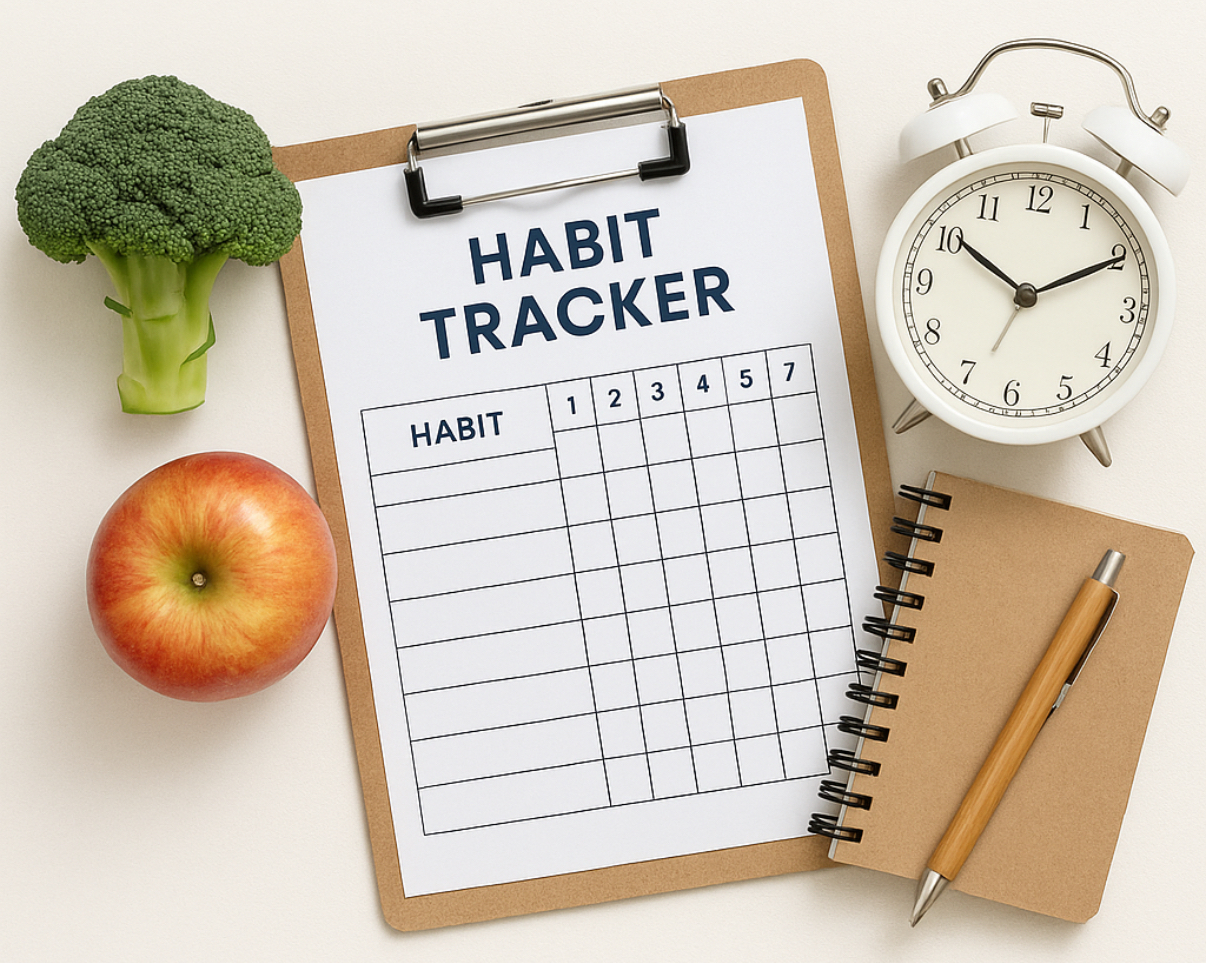
Tracking helps you stay accountable and aware of your progress. It highlights patterns, like when you’re most consistent, when barriers appear, and what supports your success — allowing for small, data-informed adjustments over time.2
Example: Keep a simple log of your weekly meal prep, vegetable intake, or bedtime routine. Seeing your data builds motivation on good weeks and insight on harder ones.
Growth Reflection Questions:
- What patterns do I notice in my consistency?
- What helped me stay on track this week, and what made it harder?
- What’s one small change I could make next week to support progress?
Practice a Growth Mindset
A growth mindset reframes setbacks as opportunities to learn rather than failures. This perspective is linked to higher resilience, better emotion regulation, and lasting behavior change.3 While this concept could fit naturally within the “Mindset” section, it’s included here, because reflection is how mindset becomes action. Each “Growth Reflection Question” is designed to help you stay curious, notice patterns, and remain open to change.
Example: If you miss a workout or skip a balanced meal, avoid all-or-nothing thinking. Instead, ask: “What got in the way?” and “How can I adjust tomorrow?” Progress builds when reflection replaces self-criticism.
Growth Reflection Questions:
- In what ways have my habits or mindset improved since I started?
- What does “progress” look like for me right now? How do I pursue consistency, not perfection?
From Tools and Strategies to Action
Lasting behavior change isn’t about discipline or willpower, it’s about structure, strategy, and self-awareness. To see how these principles work in practice, you can explore “Building Better Nutrition Habits That Last” which demonstrates how to apply the science of habit building. By understanding how cues, routines, and rewards shape your habits and applying the four-step cycle of plan, prepare, reinforce, and reflect, you create a framework for sustainable progress. Small, consistent actions practiced with flexibility and self-compassion build the foundation for long-term health. Working with a registered dietitian can help you personalize these tools, navigate challenges, and strengthen the habits that support your goals — one intentional step at a time.
References
- Gardner B, Rebar AL. Habit formation and behavior change. Trends Cogn Sci. 2021;25(8):663–676. doi:10.1016/j.tics.2021.04.004
- Tang B, et al. Time to form a habit: A systematic review and meta-analysis of habit-based interventions. Front Psychol. 2024;15:11641623. doi:10.3389/fpsyg.2024.11641623
- Orbell S, Verplanken B. The automatic component of habit in health behavior: Habitual responses, mental representations, and behavioral regulation. Health Psychol Rev. 2020;14(3):299–317. doi:10.1080/17437199.2019.1619818
- Hagger MS, et al. Self-regulation and behavior change: A meta-analysis of self-monitoring, goal setting, and feedback interventions. Health Psychol Rev. 2020;14(2):119-148. doi:10.1080/17437199.2019.1626643
- Sirois FM, Kitner R, Hirsch JK. Self-compassion, affect, and health-promoting behaviors: The role of self-regulation. Health Psychol Rev. 2023;17(1):79-103. doi:10.1080/17437199.2022.2070740
- Neff KD. Self-Compassion: Theory, Method, Research, and Intervention. Annu Rev Psychol. 2023;74:193–218. doi:10.1146/annurev-psych-032420-031047
- Burnette JL, Hoyt CL, Dweck CS, et al. A meta-analysis of growth mindset interventions: Changing mindsets improves self-regulation and health behaviors. Psychol Bull. 2023;149(6):893-924. doi:10.1037/bul0000396
Leave a Reply